It’s unclear whether marking is needed now: the internet has different dates
Truemark
There’s no mandatory marking yet; there’s a voluntary experiment until February 28, 2027. Try it while codes are free.
Semi-finished product marking · experiment until February 28, 2027
Marking semi-finished and frozen products in Chestny ZNAK is voluntary for now: an experiment runs until February 28, 2027, and codes are free. There’s no mandatory marking, and its start date hasn’t been approved. In Truemark, you can go through the whole cycle right now, including variable-weight goods at the Marking station.
An expert replies in English in the account chat in 15 minutes on average, 7 days a week
Who it fits
Truemark covers the full cycle of marking semi-finished and frozen products: ordering codes, labels, weight for each code, the code application report, introduction into circulation and UTDs.
Shops making dumplings, cutlets and dough, meat and fish semi-finished products, frozen vegetables and berries. While marking is voluntary and codes are free, you can set up the process on your own line.
You pack semi-finished or frozen products, and every package weighs differently. The Marking station prints a label with the weight, dates and code, and the weight goes straight into the code application report.
Codes are applied before customs release, and for imports from the EAEU before crossing the border. While there’s no mandatory marking, reporting codes in the declaration isn’t required.
You ship marked goods further down the chain. The UTD goes through EDO Lite with a code check before sending. Variable-weight goods go into the UTD at the price per kilogram, with the weight taken from Chestny ZNAK.
More than 2,500 companies mark their goods in Truemark, including












What gets in the way
If this sounds familiar, see how Truemark solves each one.
It’s unclear whether marking is needed now: the internet has different dates
Truemark
There’s no mandatory marking yet; there’s a voluntary experiment until February 28, 2027. Try it while codes are free.
I don’t know where the product belongs: meat products or semi-finished products
Truemark
Needs cooking: “Semi-finished products”; ready to eat: “Meat products”. You can check in our free service.
Every package weighs differently: how do I mark it?
Truemark
On Marking station: you put the product on the scales, and the printer prints a label with the weight, dates and code
One code without weight, and the code application report fails
Truemark
At the station, the code gets its weight at the moment of printing, so there are no codes without weight in the report
The operator in the shop is distracted by menus and tables, and a label can go out by accident
Truemark
In full screen: the display, the label and the print mode. Auto-print is armed only by empty scales.
No IT specialists, and assembling marking from several programs isn’t appealing
Truemark
Codes, labels, the report, introduction into circulation and UTDs: in one window. The station also needs Truemark Connect on Windows.
Products and codes
The experiment includes semi-finished products (except prepared foods), poultry carcasses, and frozen products: semi-finished products, prepared foods, fish products, vegetables, fruit, berries and mushrooms. Everything only in consumer packaging. Membership is determined by the HS code and the product name; OKPD2 codes aren’t specified in the experiment list.
Poultry carcasses, meat and offal, animal casings and stomachs, chilled and frozen semi-finished products, fat
Pelmeni and vareniki are usually registered under code 1902, and this code is on the list. Dough, ready meals and soups go here too. Take the exact code from the declaration of conformity or from a customs broker.
Frozen fish and fillets, crustaceans, mollusks, ready fish products. If such a product card has “Product with variable quantity” = YES, write to us before ordering codes: we’ll check your product group.
Frozen vegetables and mixes, fruit, berries, mushrooms, cooked vegetables
Check young cheeses and cottage cheese against the dairy product rules. Ice cream and edible ice, other waters, ice and snow.
The operator advises starting with the definition in TR CU 034/2013. A meat semi-finished product contains more than 60% meat ingredients and needs cooking before it’s ready: such goods go to the “Semi-finished and frozen products” group. A product that’s ready to eat goes to the “Meat products” group, even if it’s frozen. The operator’s example: ham. Marking of meat products is already mandatory; details on the page meat product marking. Not sure whether your product needs marking: check whether marking is mandatory →
Variable-weight marking
Variable-weight goods in this group are marked at the Marking station. You put the package on the scales, the weight stabilizes, and the printer prints a label with the weight, dates and code. The weight is already in the code application report. More about the station: marking variable-weight goods.
If the card has “Product with variable quantity” = YES, Chestny ZNAK expects the actual weight for each code. If even one code has no weight, the report gets an error for all codes.
In the product card: the “Product with variable quantity” = YES flag and the weight range
You order codes and open the station from “Code application”: the “Marking station” button in the extended report form
You put the product on the scales. The weight stabilizes, and the printer prints a label with the weight, dates and code.
You take the product off. The code with the weight is already in the code application report; after the run, all that’s left is to sign and send.
Introduction into circulation and UTDs at the price per kilogram: the weight is taken from Chestny ZNAK
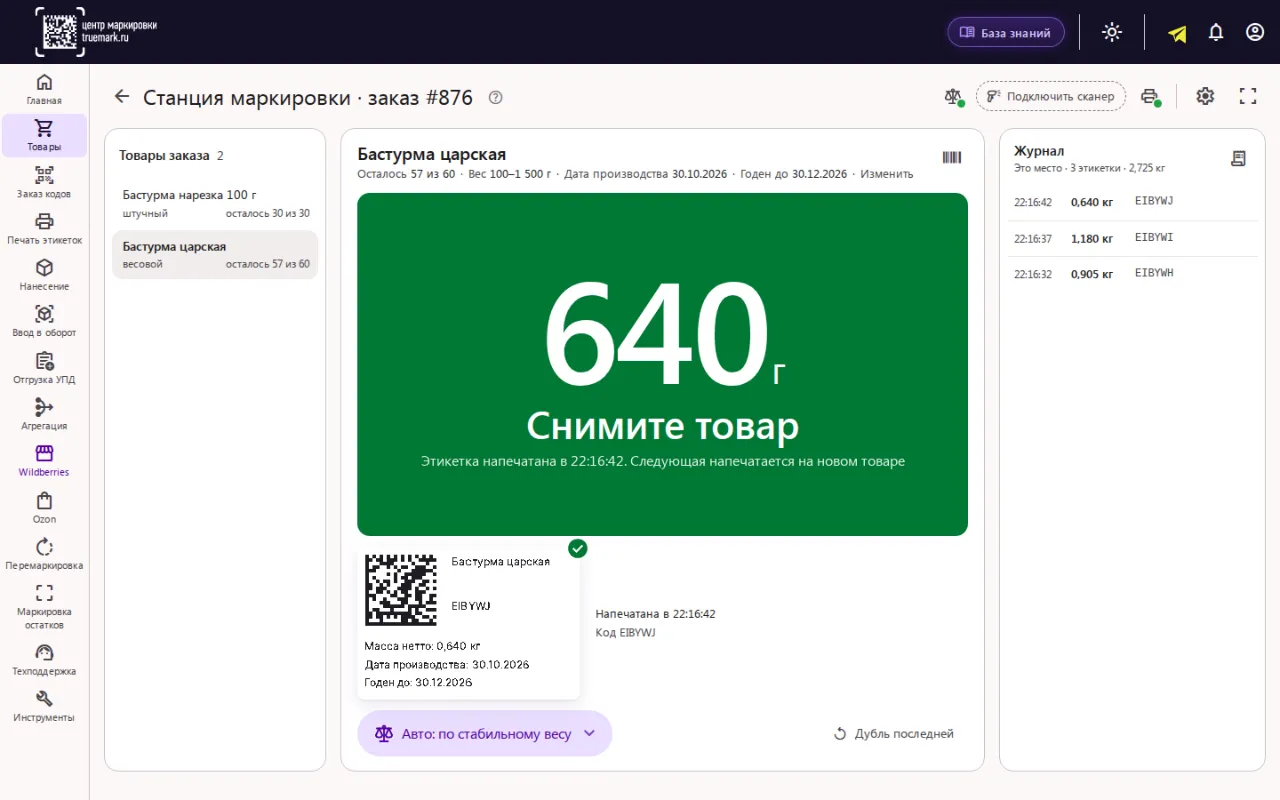
It used to take five actions per package, and the weight appeared only after a scan. Now everything is on one label at once.
| Before | Now |
|---|---|
| 1. Printed a regular label with dates | Put the product on the scales |
| 2. Printed a label with the DataMatrix | The weight stabilizes |
| 3. Applied it to the product | The printer prints a label with the weight, dates and code |
| 4. Put the product on the scales | The weight is already in the code application report |
| 5. Scanned the code. Only then was the weight recorded |
The station is built on other Truemark products. It doesn’t work without the Truemark Connect program.
The station doesn’t open on orders of sets and group packages. How to connect: scales and printer at the station. Which models fit: scales for variable-weight marking.
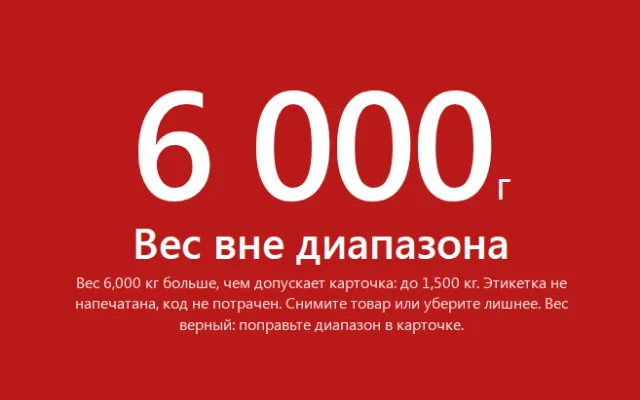
The button in the upper right corner hides the header, the account menu, the product list and the log. Nothing distracts the operator: only the display, the label and the print mode remain. Details: working with the display.
The station can add the weight to the code on the label itself: identifier 3103 and six digits. This setting is on by default and can be turned off. The weight goes to the code application report in any case. For semi-finished and frozen products, the operator’s documentation doesn’t allow this, so we advise turning the setting off: station settings. Table by group: weight in the marking code.
Rollout deadlines
Only the experiment is approved: from November 24, 2025 to February 28, 2027 inclusive. The date of mandatory marking of semi-finished and frozen products hasn’t been approved. Dates for other groups are collected in the marking calendar.
Decree No. 1099 moved the end from August 31, 2026 to February 28, 2027 and added codes 0303, 0406 10 800 0, 0504 00 000 0, 2105 00 and 2201 90 000 0 to the list
Participation is voluntary, and codes are free. They can also be used for existing stock, including after the experiment ends. Application for participation: semi_frozen@crpt.ru.
The decree hasn’t been published. In the materials for the draft on extending the experiment, the Ministry of Industry and Trade names 2027.
They were taken from a draft decree of April 30, 2026. The draft proposed registration from September 1, 2026, application and introduction into circulation from December 1, 2026 for vegetables, fruit, berries and mushrooms, from February 1, 2027 for fish and seafood, and from April 1, 2027 for other goods. The draft set circulation and withdrawal reporting for September 1, 2028, and item-level tracking for March 1, 2030. This draft wasn’t adopted. After it, the experiment was extended to February 28, 2027, so these dates can’t be treated as deadlines.
Step-by-step process
Six steps in one window. The group works the same way as other product groups.
You create product cards in the National Catalog, and Truemark pulls in ready ones. Fill in the “Product with variable quantity” attribute: YES or NO.
You order DataMatrix codes in Truemark: the request goes to Chestny ZNAK, and the finished codes come back to the account. Codes are free in the experiment.
Single items: ready templates for a label printer or A4, or your own template in the editor. Variable-weight goods: the Marking station prints a label with the weight, dates and code.
You set the production date for all products in the report at once, and Truemark calculates the expiry date from the shelf life in the card. For variable-weight goods, the weight is already in the report; all that’s left is to sign and send. More about weight in the report: variable-weight goods.
As a separate step, after application and code checks
Shipping goes with an electronic UTD with a code check before sending. Variable-weight goods go into the UTD at the price per kilogram, with the weight taken from Chestny ZNAK.
Why Truemark if you already have Chestny ZNAK
Chestny ZNAK gives you a free online account, the Markirovka.Prosto app for Windows and a mobile app. You can mark goods with them, but each tool covers only its own part, while EDI, 1C and marketplaces live separately. In Truemark, the whole journey of your goods fits in one browser window.
| Task | Free from Chestny ZNAK | In Truemark |
|---|---|---|
| Code orders | Up to 10 GTINs per order and up to 150,000 codes per GTIN | Up to 1,000,000 codes per order, any number of GTINs |
| Label printing | Markirovka.Prosto for Windows, only with a thermal transfer printer connected to that computer | An editor in the browser, printing as a PDF file on any printer or via Connect on a label printer, including a network one |
| Aggregation | Each level is a separate document: order and print KIGU codes, create SSCCs for boxes and pallets yourself, collect the codes of all contents, sign and wait for processing. Then do it all again for the pallet | Group packs, sets, boxes and pallets from the packing layout of the code order, no scanner, no need to enter the codes of the contents. Or with a scanner, or from a file. SSCC as a GS1-128 barcode |
| Shipping | UTD via EDI; exchange with 1C is set up in 1C itself | UTD by pallet code, the draft goes to 1C with the full code hierarchy |
| Goods receipt | Scanning codes in a mobile app | Every code checked before signing; goods checked with a scanner or any handheld terminal |
| Marketplaces | You enter codes for orders in the marketplace account and file withdrawals from and returns to circulation separately in the Chestny ZNAK account | Codes for FBS orders by scanner, withdrawals and returns for all orders in one click |
| Help | The operator's support line | In-app tours and an expert in chat in English, 15 minutes on average, 7 days a week |
Chestny ZNAK features are based on its knowledge base as of November 2026: code order limits, Markirovka.Prosto, Chestny ZNAK.Business.
Risks without marking
While marking of semi-finished and frozen products is voluntary, there’s no fine for a missing code on these goods: Art. 15.12 of the Code of Administrative Offenses and Art. 171.1 of the Criminal Code concern goods for which marking is mandatory. The amounts below apply to mandatory groups. They will apply to this group once mandatory requirements take effect.
A fine for producing, introducing into circulation, selling, storing and transporting without mandatory marking. The goods are confiscated.
Code of Administrative Offenses, Art. 15.12, Parts 1 and 2A fine with confiscation of the goods
Code of Administrative Offenses, Art. 15.12, Part 1A fine with confiscation of the goods
Code of Administrative Offenses, Art. 15.12, Part 2Criminal liability. For food products, a large scale starts at a value of more than ₽400,000: a fine of up to ₽400,000, forced labor or imprisonment for up to 3 years (Russian Criminal Code, Art. 171.1, Part 3). An especially large scale, more than ₽1,500,000, or a group of persons: up to 6 years (Part 4). If under the operator’s rules your product counts as a meat product, marking is already mandatory and these fines apply. Details on the page meat product marking.
Pricing
Working in the service costs the same for all product groups: plans from ₽16,900 a year, the first 7 days free. 2,500+ clients, on the market since 2019.
A marking code costs ₽0.61 in Chestny ZNAK. Ordering, printing, aggregation, UTDs, marketplaces and 1C in Truemark cost from ₽0.017 per code on the Maxi plan paid annually. All product groups and support are included.
Truemark per code is the plan price divided by its code limit for the period. Codes are paid to Chestny ZNAK separately; Truemark does not resell codes.
For small companies
₽0.085per code
₽1,409 per month · ₽16,900 per year
Included
Handheld terminal license: ₽10,000 per device
Choose MiniFor growing businesses
₽0.056per code
₽2,325 per month · ₽27,900 per year
Everything in Mini, plus
Handheld terminal license free, the next one ₽5,000
Choose Opti₽0.017per code
₽4,159 per month · ₽49,900 per year
Everything in Opti, plus
Handheld terminal license free, the next one ₽5,000
Choose Maxi| What's included | Mini | Opti | Maxi |
|---|---|---|---|
| Every product group | included | included | included |
| Ordering codes, label printing, application and introduction into circulation | included | included | included |
| UTD shipping | included | included | included |
| Automatic aggregation without a scanner | included | included | included |
| UTD receipt via EDO Lite | with a terminal license | included | included |
| 1C integration | not included | included | included |
| Re-marking | not included | included | included |
| Wildberries, FBS | not included | up to 3,000 tasks a month | up to 30,000 |
| Ozon, FBS | not included | up to 3,000 shipments, 2 stores | up to 30,000, 5 stores |
| Stock marking | not included | not included | included |
| Handheld terminal app license | ₽10,000 | 1 free | 1 free |
| Employees with an MChD and their own signature | included | included | included |
| Invited employees, no signature needed | not included | up to 3 | up to 10 |
| Employee roles: “View” and “Change” by section | not included | not included | included |
Re-marking, stock marking and EDI can be bought separately from a plan. Training in Truemark costs ₽5,000 per hour, although the guides and interactive tours in the account are usually enough.
FAQ
Didn’t find an answer? An expert replies in the account chat in 15 minutes on average. More answers in the knowledge base and blog.
No. Marking of semi-finished and frozen products is voluntary for now: from November 24, 2025 to February 28, 2027, an experiment runs under Decree No. 1823, extended by Decree No. 1099. The exception is goods that count as meat products under the operator’s rules: their marking is already mandatory.
The date hasn’t been approved: as of October 31, 2026, no decree on mandatory marking of this group has been published. The draft of April 30, 2026 proposed stages from December 1, 2026 to April 1, 2027. It wasn’t adopted, and after it the experiment was extended to February 28, 2027. In the materials for the draft on extending the experiment, the Ministry of Industry and Trade names 2027.
Participation is voluntary. The operator asks you to send an application to semi_frozen@crpt.ru. Codes in the experiment are free, and they can also be used for existing stock, including after the experiment ends.
Semi-finished products (except prepared foods), poultry carcasses, and frozen products, including semi-finished products, prepared foods, fish products, vegetables, fruit, berries and mushrooms, in consumer packaging. Codes: 0201–0204, 0205 00, 0206–0209, 0303, 0304, 0306, 0307, 0406 10 800 0, 0504 00 000 0, 0710, 0811, 1501 10 900 0, 1501 20 900 0, 1501 90 000 0, 1601 00, 1602, 1604, 1901 20 000 0, 1902, 1904 90 100 0, 1905 90, 2003, 2004, 2005, 2104, 2105 00, 2106 with exceptions, 2201 90 000 0.
Pelmeni are usually registered under HS code 1902, which is on the experiment list. So pelmeni marking is voluntary for now. Take the exact code from the declaration of conformity or from a customs broker.
The operator advises starting with the definition of a meat semi-finished product: more than 60% meat ingredients and cooking needed before it’s ready. Such goods go to the “Semi-finished and frozen products” group. A product that’s ready to eat goes to the “Meat products” group, even if it’s frozen. There, marking is already mandatory.
In the product card in the National Catalog, set “Product with variable quantity” = YES and the weight range. In Truemark, the Marking station records the weight: you put the package on the scales, the weight stabilizes, the printer prints a label with the weight, dates and code, and the weight is already in the code application report. You need a label printer, scales and the Truemark Connect program on a computer with Windows 10 or later. The scales and printer can be connected by cable or over the network.
The operator’s documentation for this group doesn’t allow it. At the station, the setting is on by default; for semi-finished and frozen products, we advise turning it off. The weight goes to the code application report in any case. Details: weight in the marking code.
While marking is voluntary, there’s no fine for a missing code on these goods. Art. 15.12 of the Code of Administrative Offenses applies to the group from the moment mandatory requirements take effect: up to ₽300,000 for legal entities with confiscation of the goods. For meat products, these fines already apply.
In the experiment, the operator provides codes for free. After mandatory marking starts, a code costs ₽0.50 excluding VAT, ₽0.61 including VAT. Work in Truemark is paid separately: plans from ₽16,900 a year, the first 7 days free. There’s one plan for all product groups.
Codes are applied before customs release, and for imports from the EAEU before crossing the border. While there’s no mandatory marking, reporting codes in the declaration isn’t required.
Veterinary documents in FGIS VetIS (Mercury) are issued under veterinary rules, just as without marking: for meat products, the operator states directly that marking requirements don’t cancel Ministry of Agriculture Order No. 862, and the information is needed in both systems (operator, August 12, 2026). In the operator’s section on semi-finished products, there’s a page about the electronic veterinary accompanying document: the manufacturer specifies its number at introduction into circulation if the products must be accompanied by such documents (operator, September 23, 2026). The operator mentions reconciliation of weight or volume with the veterinary document for meat products: from June 1, 2027, the introduction into circulation document is rejected if the weight or volume exceeds the veterinary document data by 5% or more (Government Decree No. 205, clause 31 “е”). For semi-finished products in the experiment, the operator doesn’t mention such reconciliation. If under the operator’s rules your product counts as a meat product, the meat product rules apply: meat product marking.
The experiment is voluntary, and there’s no mandatory reporting of sales through the checkout for this group. If you sold goods with a code and didn’t report the withdrawal, the code is written off with the “Write-off (general document)” document in the Chestny ZNAK personal account: this is how the operator describes codes sold before mandatory marking started, for example during the experiment (operator, September 11, 2026). For groups with mandatory marking, the procedure is: a cash register with FFD 1.2 passes the full code in tag 2000 “codeString”, the fiscal data operator sends the information to Chestny ZNAK, and the code gets the “Retired” status (operator, October 20, 2026). For semi-finished products, this procedure applies from the date of mandatory marking, which hasn’t been approved.
While marking is voluntary, the law doesn’t require codes on goods sold through a marketplace. Check the marketplace’s own rules separately. The operator shows how roles are distributed under mandatory marking with the example of dairy products (06.04.2026). FBO: the marketplace is a participant in circulation, the seller transfers goods under a UTD “Transfer to Agent”, and the marketplace withdraws the code. FBS and DBS: the seller withdraws the code with a “Withdrawal from circulation” document with the reason “Remote sale”. In Truemark, Wildberries (FBS) and Ozon (FBS) integrations are included in the Opti and Maxi plans: plans.
What Truemark offers for your case: variable-weight goods, cards in the National Catalog, labels, EDO Lite and reports to Chestny ZNAK.
An expert replies in English in the account chat in 15 minutes on average, 7 days a week. 7 days of full access for free, no card required.